
Most businesses spend the bulk of their marketing budget on getting the phone to ring, and almost nothing on what happens next. Yet for service businesses the deciding moment usually is not the search result or the ad. It is the first few minutes after someone raises their hand.
Why speed wins
When a homeowner's AC dies in August or a patient wants a consultation this week, they rarely contact just one business. They fill in two or three forms, call the first number that answers, and book with whoever makes it easy. In 2011 the Harvard Business Review published research ("The Short Life of Online Sales Leads") showing that companies responding within an hour were dramatically more likely to have a meaningful conversation with the lead than those that responded later, and that many companies took a day or more to reply at all. The tools have changed since then. Buyer patience has not improved.
The practical lesson: a lead you respond to in two minutes is worth more than a lead you respond to tomorrow, even if they cost the same to acquire.
The four parts of a response engine
1. One inbox for every lead
Leads arrive from website forms, phone calls, Google Business Profile messages, Facebook and Instagram, Google Local Services Ads, directories and email. If they land in five places, someone will miss one. Connect every source to a single CRM (HubSpot, GoHighLevel, Zoho or similar) so each lead becomes a record with its source, time and details.
2. An instant first reply
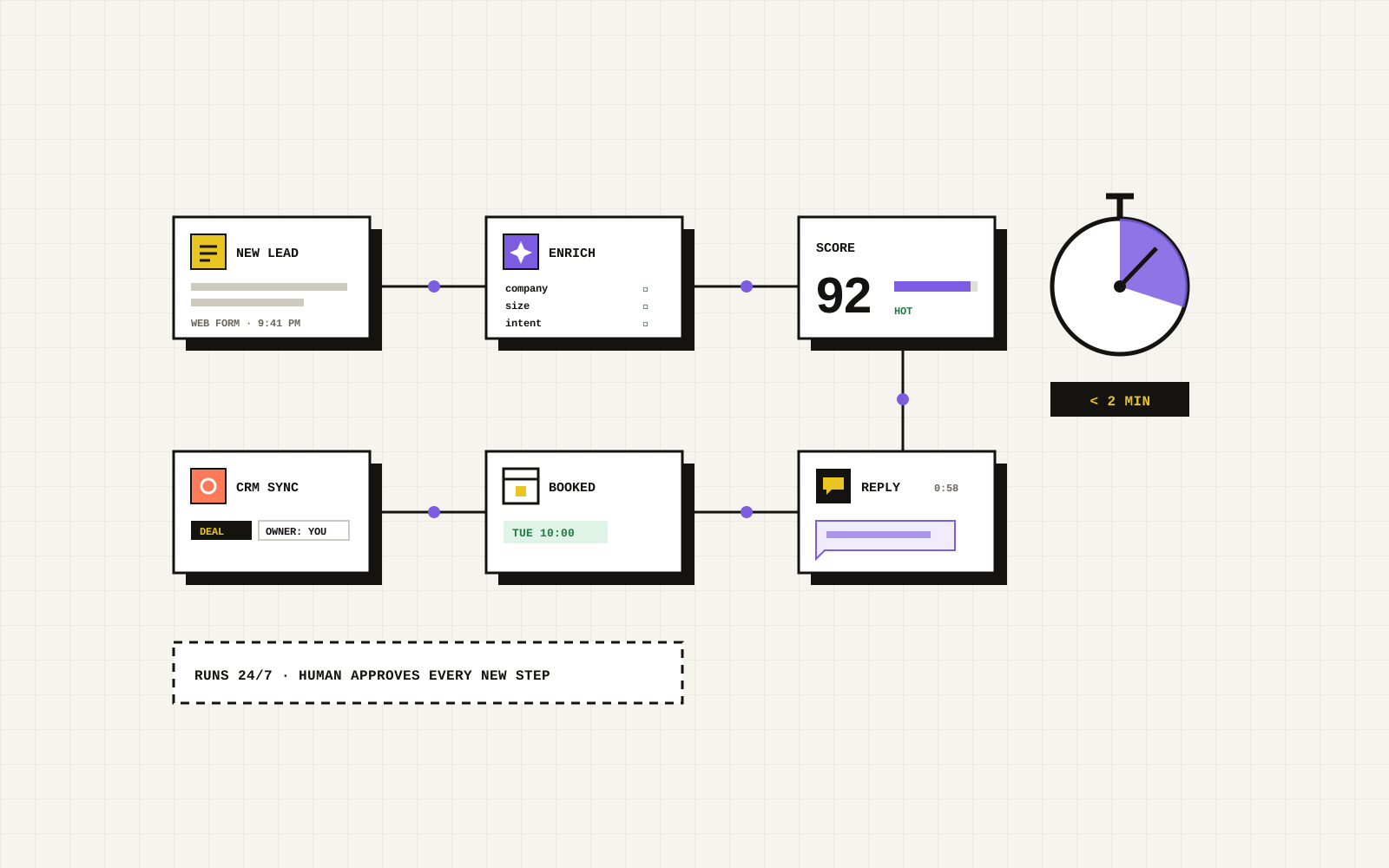
The first reply should go out automatically within a minute, by text and email, and it should sound like a person:
- Use their name and mention what they asked about.
- Say who will contact them and when ("Maria from our team will call you within 15 minutes").
- Give one easy next step, such as a booking link or "reply with a good time to call".
3. Smart routing and a human follow-up
Automation buys you time; people close. Route each lead to the right person by service, location or value, notify them instantly on their phone, and set a clear rule for how fast they must call. If nobody picks it up within the window, escalate to a second person.
For missed calls, add a missed-call text-back: when a call goes unanswered, the caller automatically gets a text so the conversation continues instead of going to a competitor.
4. Follow-up that does not give up
Many leads do not answer the first call. A simple sequence over the next seven to ten days (a call, a text, an email with something useful, a final check-in) recovers a meaningful share of them. Stop the sequence the moment they reply or book.
Where AI fits, and where it does not
AI is genuinely useful here when it has guardrails:
- Qualifying questions over text or chat (service needed, location, timeline, budget range).
- Drafting personalised first replies from the form details.
- Scoring leads so your team calls the most valuable ones first.
- Summarising call recordings into the CRM.
What AI should not do is promise prices, appointments or outcomes it cannot guarantee. Keep a human approval step for anything binding, and make it easy for the lead to reach a person.
The numbers to watch
- Median time to first reply, by source and by hour of day. Nights and weekends usually hide the biggest gaps.
- Contact rate: the share of leads you actually speak to.
- Booking rate from contacted leads.
- Cost per booked job, not cost per lead. A cheaper lead source that never answers is expensive.
What the research says (and what it does not)
You will see dramatic speed-to-lead statistics all over the internet. Some are solid, some are not, and it is worth knowing which is which before you quote them to your team:
- Solid: the 2011 Harvard Business Review study cited above found that firms that contacted online leads within an hour were nearly seven times more likely to qualify them than firms that waited even one hour longer, and far more likely than those that waited a day or more.
- Directional: the popular "21 times more likely within five minutes" figure traces back to a 2007 vendor study of call logs at a handful of companies. It measured qualification, not closed deals.
- Unsourced: the claim that "78% of customers buy from the first company to respond" is repeated everywhere but has no primary source we could find.
The honest conclusion is still strong: most companies reply slowly or not at all, and fast first contact is consistently associated with better qualification. You do not need a precise multiplier to know that being first is an advantage you can build.
A 90-second response blueprint for service businesses
- 0 to 60 seconds: an automatic text and email confirm the request, name the person who will reach out, and offer a booking link.
- 1 to 5 minutes: the lead appears in the assigned person's phone with a one-tap call button and the details they need.
- 5 to 15 minutes: if the call is not answered, a text goes out ("Sorry I missed you, is now or later today better?") and the lead is escalated if nobody has called.
- After hours: the auto-reply sets an honest expectation ("We open at 8 a.m. and will call you first thing") and offers self-booking, so the lead is not left waiting in silence.
Connect speed to the rest of your marketing
Speed only pays off if the right leads arrive and you can see which ones turn into revenue. Send source and outcome data back to your ad platforms using the approach in our guide to connecting ads to real revenue, and make sure the page that collects the lead passes the five-second test. Our AI automation and email and CRM teams build this response engine end to end.
A simple starting point
You do not need a big system to start. This week: send every form to one inbox, set up an automatic text reply, turn on missed-call text-back, and check your median response time. Then build from there. If you want help wiring it into your CRM and ads, our AI automation team sets this up as part of every growth engine.
Frequently asked questions
What is speed to lead?
Speed to lead is how quickly your business makes first contact with someone after they raise their hand, by submitting a form, calling or messaging. It is usually measured as median time to first reply, split by lead source and hour of day.
How fast should I respond to a new lead?
Aim for an automatic acknowledgement within a minute and a human call or personal message within five to fifteen minutes during business hours. After hours, an immediate reply that sets a clear expectation for when you will call is far better than silence.
Does an automatic reply count as responding?
It helps, but it does not replace a person. The automatic reply holds the conversation and gives the lead a next step, while a real call or tailored message is what usually books the job. Treat the automatic reply as the start of the clock, not the end.
What should I track to know if it is working?
Track median time to first reply, contact rate, booking rate from contacted leads and cost per booked job. Cost per booked job matters more than cost per lead, because a cheap lead source that never answers is expensive.